
View the guide below or download to your device
Tired all the time? Hair shedding? Cold hands, restless legs, out of breath on the stairs? You may have been told your labs are "normal." Ferritin is your body's iron savings account, and it can run low long before you become anemic. This guide explains what the numbers mean, why your stores run down, and how to rebuild them over about three months. 1. What Ferritin Is and Why Labs Miss It Ferritin is a protein that stores iron, mostly in your liver, spleen and bone marrow. Your blood test measures the small amount that circulates. Hemoglobin, the number used to check for anemia, is more like your checking account. It only drops after your savings are drained. That is why you can feel depleted while your blood count still looks fine. New 2026 guidelines: the ranges have changed Many labs still flag ferritin as low only below about 10 to 15 ng/mL. In September 2026 the American Society of Hematology (ASH), the leading group of blood specialists in the U.S., published new guidelines that raise those cutoffs. You can be iron deficient at these levels even if you are not anemic.
1. What Ferritin Is and Why Labs Miss It
Ferritin is a protein that stores iron, mostly in your liver, spleen and bone marrow. Your blood test measures the small amount that circulates. Hemoglobin, the number used to check for anemia, is more like your checking account. It only drops after your savings are drained. That is why you can feel depleted while your blood count still looks fine.
New 2026 guidelines: the ranges have changed Many labs still flag ferritin as low only below about 10 to 15 ng/mL. In September 2026 the American Society of Hematology (ASH), the leading group of blood specialists in the U.S., published new guidelines that raise those cutoffs. You can be iron deficient at these levels even if you are not anemic.
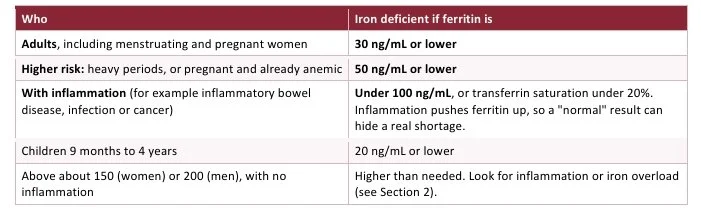
Our goal for rebuilding: at Thriving with Eastern Medicine and Acupuncture, we aim for a ferritin of 50 to 100 ng/mL. This is the range where most people notice their energy, hair and sleep coming back.
Ask for the full picture, not ferritin alone Because inflammation can raise ferritin, one number is not enough. Ask your provider for: ferritin, a complete blood count (CBC), serum iron, TIBC, transferrin saturation (how much of your iron "delivery truck" is loaded; under 20% suggests you are low) and hs-CRP (a simple inflammation marker). Test in the morning, and skip any iron supplement for 24 hours beforehand.
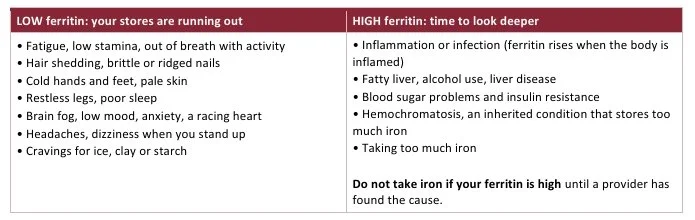
2. What Low and High Ferritin Mean
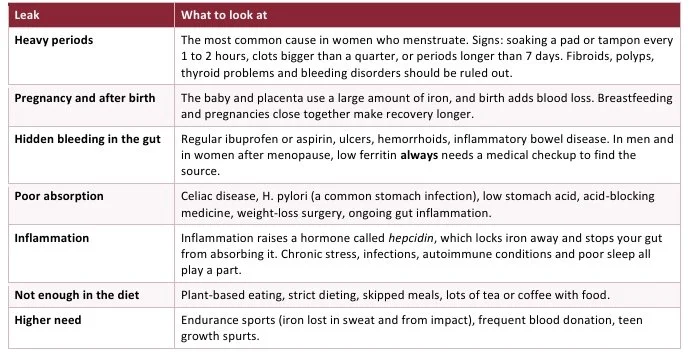
3. Common Causes
Find and Plug the Leaks Your body does not waste stored iron. When more iron leaves than comes in, the liver and bone marrow release their reserves to keep making red blood cells, so ferritin keeps falling. Rebuilding only works once the leaks are plugged. The causes fall into three groups: losing more, absorbing less, or needing more.
4. Rebuilding Through Food

Pair it: boosters to eat with iron
• Vitamin C at the same meal can raise plant iron absorption several times over: bell peppers, citrus, kiwi, strawberries, tomatoes, broccoli, Brussels sprouts. Even a squeeze of lemon helps.
• A little meat, fish or poultry with plant foods helps you absorb the iron in beans and greens.
• Orange and yellow vegetables (sweet potato, carrots, squash) contain vitamin A, which helps your body use stored iron.
• Build the blood, too: vitamin B12, folate and copper are needed to make red blood cells (eggs, leafy greens, shellfish, nuts).
• Cook in cast iron. Acidic dishes like tomato sauce pick up extra iron from the pan. Avoid: blockers to keep away from iron meals
• Coffee and black or green tea: wait at least 1 to 2 hours after an iron-rich meal. • Calcium (dairy, calcium supplements, antacids): have these at a different meal.
• Phytates, natural compounds in whole grains, beans and nuts that bind iron. Soaking, sprouting and sourdough reduce them.
• Zinc or high-dose mineral supplements taken at the same time as iron.
Timing it
• Make lunch or dinner your main iron meal, add vitamin C, and move coffee or tea to mid-morning.
• If you use an iron supplement, research shows that taking it every other day can be absorbed as well as or better than daily, with less stomach upset. Ask your provider about the right dose and form for you.
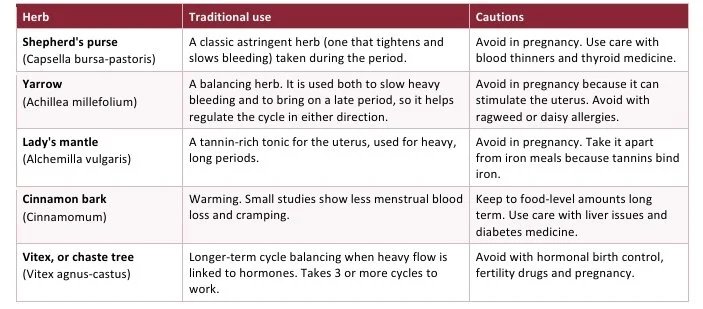
5. Western Herbs for Heavy Periods
These traditional herbs are used to help tone the uterus and ease heavy flow. The research on them is limited, so use them with guidance and alongside a medical checkup.
6. Calming Inflammation That Blocks Absorption
When inflammation is high, your body holds on to iron and your gut stops absorbing it, no matter how much you eat. Two gentle options:
• Ginger (Zingiber officinale): calms inflammation and supports digestion and appetite. Try fresh ginger tea or cook with ginger daily. Use care with blood thinners and before surgery.
• Turmeric (Curcuma longa): well studied for lowering inflammation. Important: its active compound, curcumin, binds iron, and high-dose supplements have been linked to low iron. Take it at least 2 hours away from iron meals or supplements, or use it only as a spice in cooking while you rebuild. Use care with gallstones and blood thinners. Just as important is calming the source of inflammation: sleep, stress, gut health and steady blood sugar.
7. The Chinese Medicine View
Chinese medicine has no word for ferritin, but it has described the same picture for centuries. Low ferritin most often matches a pattern called Blood Deficiency (Xue Xu). In Chinese medicine, "Blood" means more than red blood cells. It is the deep nourishment that feeds your hair, skin, muscles, sleep and mood.
A few simple ideas help make sense of the patterns below:
• Qi (say "chee") is your body's energy and function.
• The Spleen stands for your whole digestive system. It turns food into Blood and keeps Blood in the vessels, so a weak Spleen can mean both poor absorption and heavy bleeding.
• The Liver stores Blood and releases it for your cycle. The Heart houses the mind, so low Heart Blood shows up as anxiety and poor sleep. The Kidneys hold your deepest reserves, which build bone marrow.
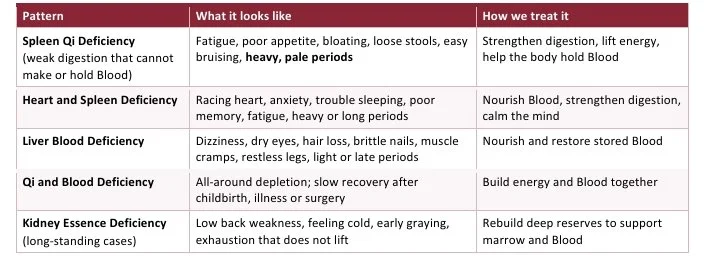
Heavy bleeding can also come from Heat in the Blood (bright red, heavy flow, feeling warm) or Blood Stasis, meaning Blood that is stuck (dark clots, sharp cramps, fibroids). These are active leaks, so we treat them first.
Eating for your pattern
• Warm, cooked, easy-to-digest meals such as soups, stews and congee (rice porridge) support digestion. Limit iced drinks and large amounts of raw, cold food.
• Blood-building foods: bone broth, beef, lamb, liver, eggs, black beans, black sesame, beets, dark leafy greens, red dates (jujube), goji berries, longan fruit. • Eat regular meals and chew well. Skipping meals weakens digestion over time.
Three simple recipes
Red Date and Goji Congee (supports digestion and Blood). Simmer ½ cup rice in 5 cups water or bone broth with 6 pitted red dates and 3 slices of ginger for 60 to 90 minutes, until creamy. Stir in a small handful of goji berries for the last 10 minutes. Top with a soft-boiled egg and black sesame.
Beef, Spinach and Red Pepper Stir-Fry (animal iron plus vitamin C). Stir-fry thinly sliced beef with garlic and ginger in a cast iron pan, then add sliced red bell pepper and a big handful of spinach until wilted. Finish with tamari and lemon juice. Serve over rice.
Lemony Lentil and Sweet Potato Soup (plant-based). Sauté onion, carrot and garlic; add 1 cup rinsed lentils, 1 diced sweet potato, 1 can of tomatoes and 5 cups broth. Simmer 30 minutes. Stir in chopped kale, then add a generous squeeze of lemon just before serving.
Herbal formulas commonly used
Chinese herbal formulas are blends of several herbs that work as a team. These are some of the most common for rebuilding Blood:
• Si Wu Tang (Four Substance Decoction): the foundational formula for nourishing Blood. • Ba Zhen Tang (Eight Treasure Decoction): builds energy and Blood together.
• Gui Pi Tang (Restore the Spleen Decoction): for heavy periods with poor sleep, worry and fatigue.
• Dang Gui Bu Xue Tang (Dang Gui Decoction to Tonify the Blood): a simple two-herb formula for depletion after blood loss. • Bu Zhong Yi Qi Tang (Tonify the Middle and Augment the Qi): when weak digestive energy cannot hold Blood in place.
There are many more options. The right formula depends on which type of Blood Deficiency you have, and matching it correctly is what helps you in the long run.
Meet with a licensed acupuncturist and herbalist before starting any formula. Herbs can interact with medications and are not right for everyone, especially in pregnancy. A practitioner will match the formula to your pattern, which can help restore ferritin faster than food alone.
8. Your 3-Month Rebuild Plan
Red blood cells live about 120 days, and your stores only refill once your blood count is taken care of. That is why rebuilding takes about three months of steady work.
1. Test: ferritin, CBC, iron panel, transferrin saturation and hs-CRP. Keep a copy of your results.
2. Find the leak: heavy periods, gut issues, medications, inflammation. See a provider for anything unexplained.
3. Eat for iron every day: one iron-rich meal a day with vitamin C, with coffee and tea moved away from meals.
4. Support with herbs and acupuncture, matched to your pattern by a licensed practitioner.
5. Retest at 3 months to see how far your ferritin has been restored, then adjust the plan from there.
See a doctor promptly if you have: black or bloody stools, vomiting blood, chest pain, fainting, severe shortness of breath, soaking through a pad or tampon every hour, or low ferritin as a man or after menopause. This guide is for educational purposes only and does not replace medical advice, diagnosis or treatment. Do not start iron supplements or herbs without talking to a qualified provider, especially if you are pregnant, breastfeeding or taking medication.
Ready to Rebuild?
References
American Society of Hematology (2026). ASH 2026 guidelines for diagnosis of iron deficiency. Blood Advances. doi:10.1182/bloodadvances.2025015950 WHO (2020). Guideline on use of ferritin concentrations to assess iron status in individuals and populations. Pasricha SR et al. (2021). Iron deficiency. The Lancet 397:233-248. Addo OY et al. (2025). Physiologically based serum ferritin thresholds for iron deficiency among women and children. The Lancet Global Health. Stoffel NU et al. (2020). Iron absorption from supplements is greater with alternate day than with consecutive day dosing in iron-deficient anemic women. Haematologica 105:1232-1239. Hallberg L, Hulthén L (2000). Prediction of dietary iron absorption. Am J Clin Nutr 71:1147-1160.